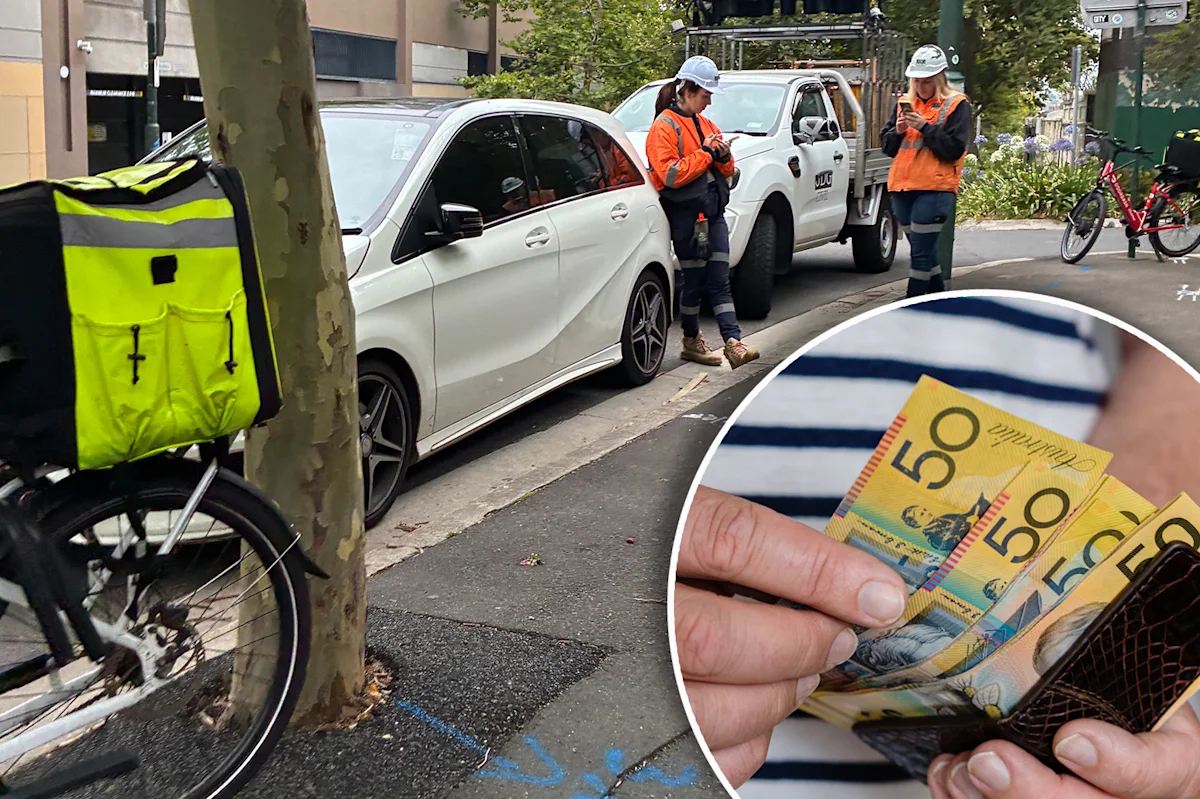
For Aussies looking to make extra cash around work and family commitments, food delivery can seem like the perfect side hustle — choose your own hours, jump in the car and earn money when it suits you.
And with a new $31.30-an-hour safety net, the numbers can look attractive too. But Yahoo News Australia modelling shows that headline rate can effectively shrink to about $10 an hour once unpaid time, tax and vehicle costs are factored in.
University of Sydney employment expert Dr Caleb Goods agreed the modelling showed gig work could be far less lucrative than the headline rate suggests, while other experts warned overlooked costs could even leave workers out of pocket.
Goods said declining real wages were a major reason some Australians were increasingly looking for a second source of income.
“The average working Australian is thousands of dollars worse off than they were four or five years ago,” he told Yahoo News Australia.
“One way that workers make up that income gap is working a second job, such as doing gig work.”
The catch with the promised $31.30 hourly rate
The new $31.30 minimum only applies while a driver is actively completing an order, from acceptance to drop-off, excluding time spent waiting for orders, travelling to busy areas or driving between jobs without an order.
For our hypothetical, we’ve assumed it takes 20 hours logged on to accumulate 15 hours of paid “engaged time”, generating $469.50 — an effective rate of $23.48 an hour before tax and vehicle costs.
How much of your side hustle income actually goes to tax?
Tax can take a significant chunk out of the headline earnings, particularly for Australians taking on delivery work on top of an existing job.
CPA Australia Tax Lead Jenny Wong told Yahoo News Australia that Aussies already earning more than $45,000 a year in their main job face a 30 per cent marginal tax rate plus the two per cent Medicare levy on additional income.
“Roughly one-third of every extra dollar they earn from a delivery side hustle could go towards tax and the Medicare levy,” she said.
“You can only claim the tax-free threshold in relation to one job. If it’s claimed for more than one job, you are more likely to be required to pay top up tax than get a refund.”
Food delivery and rideshare platforms do not automatically withhold tax. Workers receive their earnings upfront and must set aside enough to cover their eventual tax bill.
“The money lands in your account and can feel like extra spending money, but part of that really belongs to the tax office,” Wong said.
And for anyone thinking their side hustle income might fly under the ATO’s radar, Wong had a warning.
“The ATO has sophisticated data-matching systems and receives information directly from many digital platforms, so it’s important that all income is declared correctly. Not declaring all of your income, even if it feels minor, is a risk.”
Assuming our hypothetical driver earns more than $45,000 in their main job, $150.24 would need to be set aside for tax, leaving $319.26 — an effective $15.96 an hour before vehicle costs.
While drivers may be able to claim some vehicle expenses at tax time, tax expert Dr Adrian Raftery, better known as “Mr Taxman”, warned against assuming they can simply claim everything back.
“The biggest mistake is thinking that they can claim 100% of their car or mobile phone,” he told Yahoo News Australia.
“You need to apportion between private and business for any deduction. For those using their car, a 12-week logbook needs to be representative of their yearly travel to substantiate claims.”
What are the vehicle costs associated with gig work?
To put a value on that expense, Yahoo News Australia used the 53-cent-per-kilometre allowance paid to eligible employees under the Fast Food Industry Award when they use their own vehicle for deliveries.
Gig workers don’t automatically receive the allowance, but it provides a useful benchmark for the cost of using a private vehicle for work.
For our hypothetical driver using a petrol vehicle, covering 225 kilometres, that equates to $119.25. Deducted from the $319.26 remaining after tax, the driver will be left with about $200 for the week — or just $10 an hour across the 20 hours logged on.
That’s less than half Australia’s $26.44 national minimum wage.
What the delivery platforms say
Uber defended the new minimum standards, saying the rate was designed as a safety net rather than a limit on what delivery workers could earn.
“The order establishes a guaranteed minimum earnings rate for delivery workers across Australia. This is a floor, not a ceiling and the majority of Uber Eats delivery workers already earn above this and will continue to do so,” an Uber spokesperson told Yahoo News Australia.
Uber said the changes would give workers greater certainty regardless of which delivery platform they chose, while maintaining the flexibility that attracts people to gig work.
“Gig work plays a critical role in the Australian economy and is a popular choice of flexible work,” the spokesperson said.
“Over 200,000 people already choose to earn on the Uber platform alone and this reform will make gig work an even more attractive proposition for Australians.”
The company said the reforms showed stronger worker protections could coexist with flexible working arrangements.
DoorDash similarly defended the changes, saying the new minimum standards provided an “industry-wide safety net” while preserving the flexibility and independence of gig work.
A spokesperson stressed the minimum rate was a baseline and drivers could earn more during busy periods.
“We know that Dashers have choices when it comes to earning money, including working for competitors, which is why we work hard to make DoorDash an attractive platform for making additional income,” they said.
DoorDash said it also provides drivers with information about where demand is highest to help them maximise their earning opportunities.